
Rowhouses
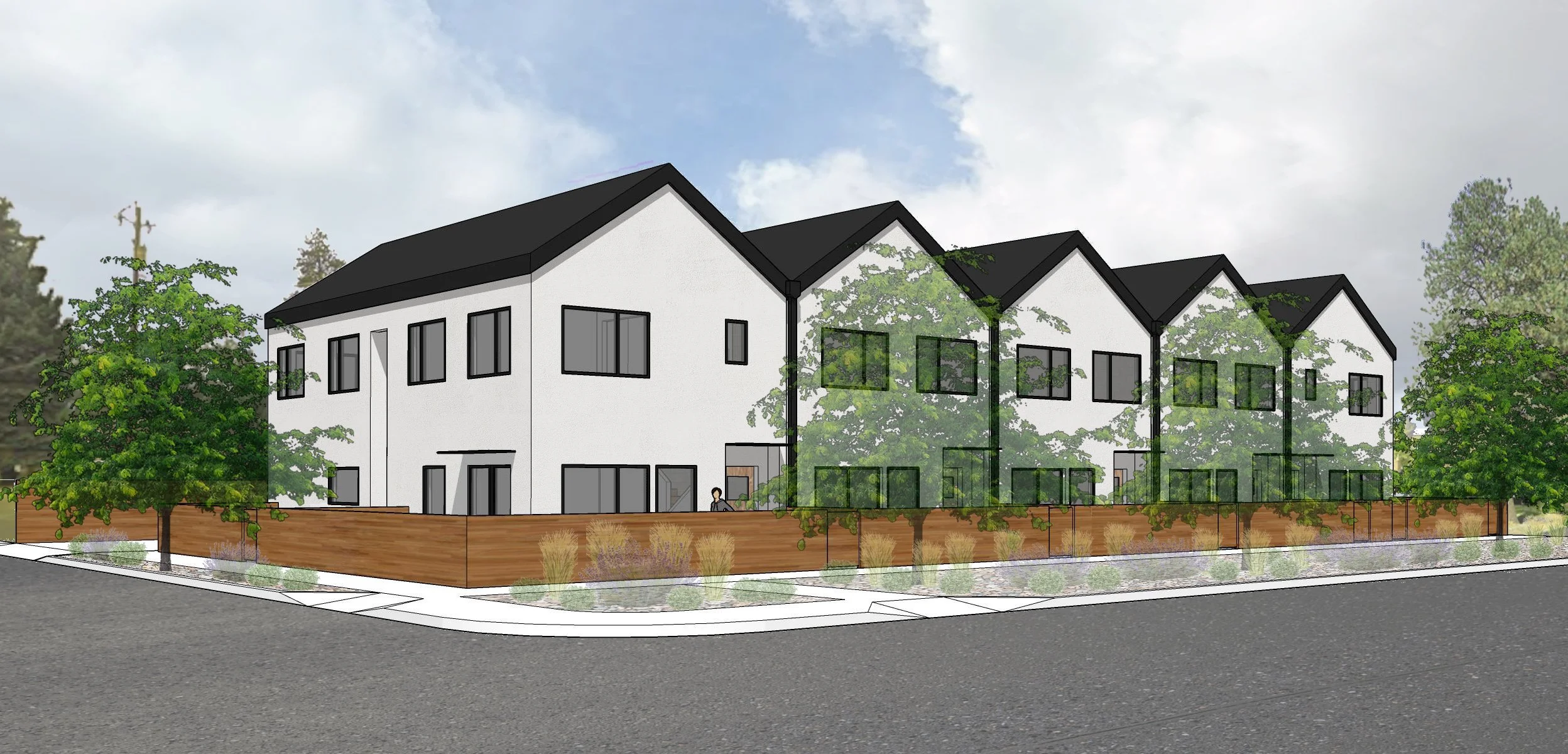
Schematic design rendering for a rowhouse development by Starr Designs & Architecture
Bend City Council just voted to modify the Bend Development Code to include what the Bend Planning Department is calling “rowhouses”. See the OPB article here for additional information.
A little over a year prior, Starr Designs & Architecture, working with Bend YIMBY, proposed this new building type as a way to create more housing by increasing infill housing options and potential. As implemented, rowhouses are very similar to the townhouse style developments that have been built in Bend for years now, but they differ in a couple of ways.
The first difference is the delivery method.
In townhomes, the block of townhouse units are grouped together into a single building. This building is designed, permitted, financed, and built as a single structure. The townhouse collective structure will have what are called “party walls” between each home that often consists of two framed walls with only a couple of inches between them. Once the entire structure is completed, the property is divided into smaller lots with property lines drawn down the middle of the space between these framed walls. At this point, each townhouse home becomes its own property and can be bought and sold similar to any other single family home.

A townhouse collection is built on an oversized lot. Once all construction is completed, the original property is subdivided between the party walls between townhouse units.
Because of this delivery method, a developer must be able to build all of the townhouse units at once. This means much larger loans and much more initial investment capital. Additionally, the larger loans mean that larger swings in financing costs (increased loan rates) will mush more drastically affect one of these projects. As a single project, is also means that if the project is put on hold, or canceled outright, then all of the homes in the townhouse complex are lost as potential homes for people.

An oversized lot can be subdivided into rowhouse lots. These lots can then be developed with individual units in any order desired.
In rowhouses, the development path matches that of a typical single-family detached home. That means the lot is divided first and then each home is built independent of one another. This means a lot can be divided and improved, with individual utilities (i.e. water and sewer laterals), and then sold. Or the rowhouse can be built prior to being sold. It also means you can finance and build one house at a time with the sale of each prior home financing the next. This flexibility makes it much easier to finance a smaller development.
The second difference relates to their structure and flexiblity.
Because these townhouse homes are built so close together, and they must be built as a unit, they are often structurally tied to one another to ensure they move as a unit and don’t damage one another in a lateral event (ex: wind storm or earthquake). This is often done as minimally as possible, but it still means the homes are tied together. This means modifying one home requires evaluating the entire colection of townhouse homes that are structurally connected. This makes it very difficult for townhouse units to change as needed by the homeowner.
Because rowhouses are built one at a time, they must be structurally independent of one another. The only stipulation then is that they are designed and spaced so that they will not encroach over the property lines. This really only takes a couple extra inches to do.
What this then means is each rowhouse is its own structure and can be modified however each owner sees fit as long as it’s still structually sound and meeting the planning code requirements. That means you can open up a floor to create double height spaces, add another floor, move interior walls around, or add an ADU for rental income or multigenerational living.
In other words, a townhouse can’t grow with you, but a rowhouse can.
This is nothing new.
While this may seem different and new, it’s really a very old style of building. We used to build homes like this in cities all over until zoning laws made this building type illegal. This building type is still done on the east coast of the USA and in European countries like the Netherlands.
This change is truely excting and we are very greatful for the support of both Bend YIMBY and the City of Bend for seeing the potential and making these changes.